16.2.12

Go Ahead, Criticize Me for Creativity

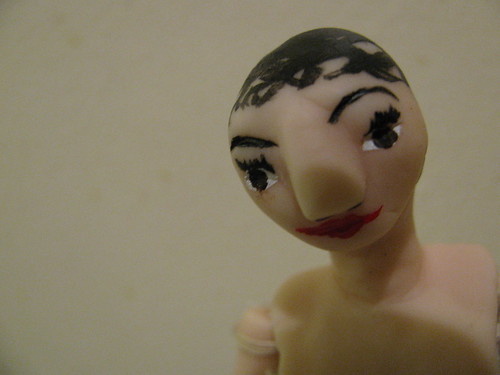
Doll by Sara

A few days ago I wrote to a friend, someone I actively work with these days, and apologized. I felt like maybe I'd not been agreeable enough lately.

To my great surprise, she wrote back and said I should not apologize. She loves the way we work together—how we freely criticize each other's ideas, to reach toward a common goal outside of ourselves, to be as creative as we can possibly be and find the best solutions.

I felt a great sense of comfort in her words. To think, she believed that our process needn't be all simple and agreeable. What a relief.

But tonight, reading The New Yorker, I discovered I should be more than relieved. I should be really, really pleased to have a relationship like this.

It turns out that the old idea of brainstorming and being agreeable about all ideas that are put on the table is not the best way to produce optimal creativity and quality solutions.

In a study by Charlan Nemeth, at U.C. Berkeley, it was noted, "Our findings show that debate and criticism do not inhibit ideas but, rather, stimulate them relative to every other condition."

In my world, I'd still like the criticism to be respectful, even playful, but now I can relax and enjoy a good debate, seeing it for the creative possibility it presents.

I might even send this little message to my friend, "Go ahead, criticize me—for our best creativity."


Doll Sculpture by Sara.

Labels: ,

22.11.11

What if You Have a Genius?


"And what if the genius is yours for one exquisite moment of your life," says Elizabeth Gilbert, "and then you pass it along?"

(I feel this way about the writing I've done. I feel like if I never accomplish anything major again, then the process of passing it along to those I teach and mentor is something beautiful and just as exquisite in its way.)

Labels: , ,

17.10.11

Steve Jobs Comes to Lunch with Creativity

Sara Touching Grasses 1

Over lunch the other day, I was talking to a friend of mine. He's working on his PhD in the area of user experiences, mostly technology.

His opinion of what Steve Jobs did best? Take stuff that already existed and find ways to put it together. This fascinated me; after all, we think of Jobs as the one who "created" some of these technologies. My friend said it wasn't like that. Instead, Jobs often saw possibilities in disparate pre-existing technologies and put them together to create beautiful user experiences.

This reminds me of today's chapter in Mindfulness, which focuses on creativity. Creativity doesn't necessarily create out-of-nothing. It simply does a quarter-turn and says, "Ah, look at it this way."

If this sounds easy, it may not be. My friend laughed as he put his iPhone on the table and said, "Isn't it beautiful? And even when other companies had it sitting in front of them, they still couldn't create a decent knock-off. That's genius, don't you think?"

I often wonder how well we are cultivating this kind of genius in the way we teach our young people, giving them, as Langer notes, too few choices in how they interact with materials and information; I know that my own daughter is chaffing against her distance-learning program this year, because it prescribes more than she's used to (we're working on that... maybe later this week I'll share her next assignment, which she took *more* than a quarter-turn with).

How much are we willing to do the quarter turns? How much does creativity matter to us? It might mean a "bad grade" or some commercial failures along the way. Will we risk it?

Labels: , ,

10.8.11

Resist! Your Creativity Depends on It

on the HIghline

When I was a new teacher, I remember reading Vygotsky. His thoughts about the Zone of Proximal Development were particularly intriguing, suggesting that we learn best when we are pushed to the edge of our competencies.

Being pushed OVER the edge? Not so useful. Finding the balance, the "cutting edge," or the "learning edge" as it were, is the challenge.

For this reason, we need others. Not huge disassociated groups of others, but others who engage with us closely and dynamically.

While I have gotten very excited about Piaget's ideas, which focus more on self-initiated learning, I'm just now coming back to Vygotsky and the thought that social interaction is critical for learning.

In regards to home education, this means I'm looking for ways to get my girls closer to the edge of their competencies, through new social opportunities. Most likely I'll sign them both up for Comedy Improv classes this Fall. My younger daughter tried Comedy Improv in a camp a few weeks ago, and it has such wonderful possibilities, offering "learning edge" experiences on both the cognitive and social levels. (Plus, it's collaborative, which I love. :)

Resistance, which Psyblog notes is best for optimal creativity, is built in to a "learning edge" type experience. So this Fall, we shall resist (albeit alongside laughter).

____

For more thoughts on the value of Resistance, but in a work context, check out my post today at Bibledude.net. Call Me Glinda: Tension and Relief for Successful Work Teams

Labels: , , ,

30.7.11

The Lady Gaga Approach to Education

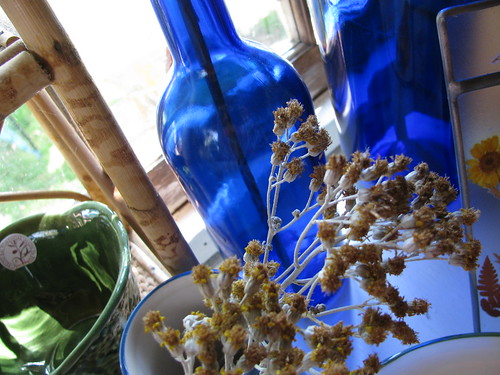
blue bottles

I tell of it here: how Lady Gaga influenced my spiritual practice for the upcoming year.

It has something to do with the surprising complexity of her music. (Frankly, I never paid attention to her, until she broke Amazon.)

What struck me about the Lady? Her influences. You can listen to her music and hear an over-the-top, rather naughty lyricist, or you can listen and hear the past: Rock, Classical, even Spirituals. She's paid attention to details. She may play the counter-cultural naughty girl, but she's got creative roots. And they're what make her music so fascinating. (Even if you don't catch it at first, because all you see is black leather and bleach.)

It occurred to me today that I take the Lady's approach to home education. I have taken my girls to the past and around the world, whether it's through history, architecture, food, science, or literature. They've developed roots through a complex array of details and experiences.

There was a time that this approach to education made me nervous. What if they missed something important that could be provided in a pre-packaged curriculum? What if all our uncharted reading and looking and touching and eating and listening wasn't enough?

By now, it is too late to be nervous. The core of their education has been provided. They are 12 and 14.

But I look at their writing. I listen to their improv music. I hear their opinions. And I realize it is okay. They have what they need to be creative, interesting people in this world. And, if all goes well, they won't break much. (Unless it's Amazon for a day. That would be all right with me. :)


Blue Bottles photo, taken at one of our favorite places: Kitchawan Farm.

Labels: , ,

15.3.10

Graphic Novel Experiment

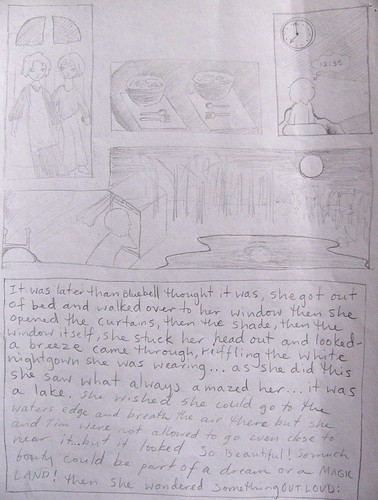
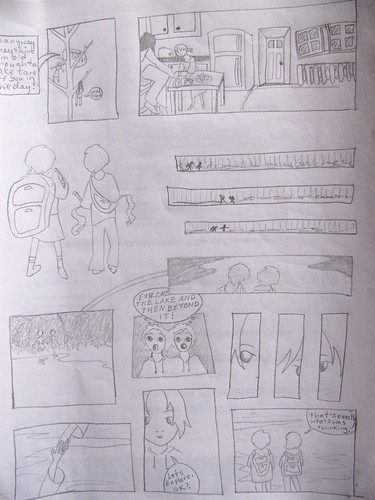
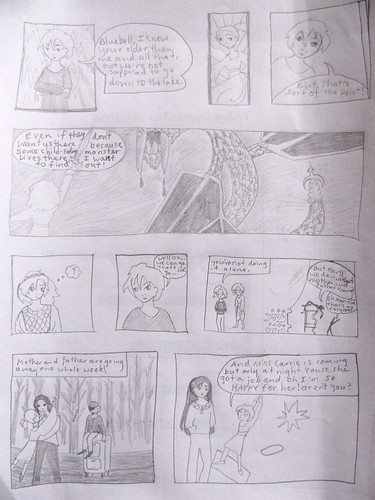
Beyond the Lake 3

Beyond the Lake 2

Beyond the Lake 1

These things always surprise me. One day my kids aren't doing something. The next day they've made a discovery and are moving full steam ahead.

Right now, it's graphic novels.

My Littlest, who has never liked to read, is gobbling them up. My Eldest is creating them in every spare moment. And I'm just along for the ride.


Away Beyond the Lake book by Sonia, 10; illustrations by Sara, 12. Used with permission.

Labels: , , ,

1.3.10

A Closet of One's Own

Box Closet

I am on Art Pilgrimage.

Recently I decided to refocus my journey by using The Artist's Way. It's a path to creative recovery.

Was I feeling in need of recovery? No.

But now I wonder.

Cameron suggests doing three pages of long-hand writing every day. She says we should take ourselves on Artist Dates. I am doing these things, and it is spurring me to the oddest responses.

Take my bedroom closet for instance.

It was one of those shut-the-door-before-you-get-buried-by-the-avalanche closets. Maybe it was a picture of my mind. Maybe now that my mind is unfolding, relaxing, finding its way, I knew instinctively to clean my closet.

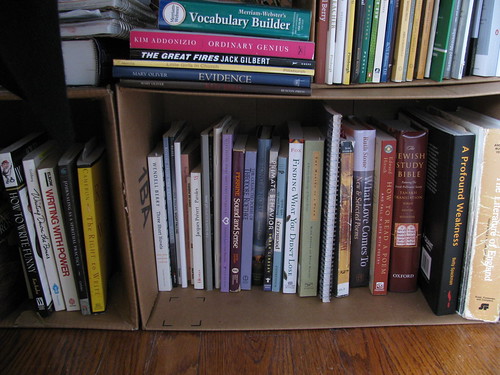
So I threw away a lot of things, carted some heavy-duty boxes from the basement (my version of California-Closet organizers), and made a secret place for my books beneath wool sweaters, cotton shirts and a yet-to-be worn dark lavender nightgown. (This effort has also produced a clean red oak floor beside my bed).

So I have a closet of my own. And this simple thing makes me happy.

Box Closet 2


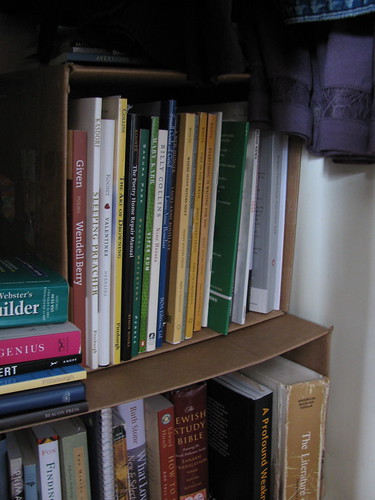
Books in the Closet photo, by L.L. Barkat.

Labels: , , ,

10.2.10

Creativity Blooms with Time

rocks at sea

I'm convinced that creativity finds its deepest expressions when afforded time. Today my Eldest moved slowly from one creative endeavor to another&mdash all self-chosen. Teaching herself Old English (I don't know why), teaching herself Gregg shorthand (because... um... ?), playing wild and poignant improvisations on piano, and finally when evening came... writing.

It is the writing I can share with you. But in it I feel all the other things lurking. And so you can have a small peek at today's creativity...

The Forgotten Land a short story by Sara, 12.

There were forty-five men on the ship.

She washed up, at first, an abandoned wreck, tattered sails, carrying more water in her holds than food or treasure. The rocks, hidden in the waves and sharp as teeth, had cut through the wood, but the ship had brought them there with her last breaths.

There was no sign, now, of the storm that had brought them to these shores, the waves splashed calmly against the sand, unconcerned. Forty-five men staggered onto dry ground, looked upon the strange land they had stumbled on. The sand stretched as far as the eye could see in all directions but the one they had come from.

They were not in good spirits. Ten wanted to go this way, ten wanted to go that way, ten would go forwards and the rest thought their fortunes could not get any worse no matter what direction they went, and didn't care.

Finally, they decided to go one day to the north. Then, if all was unchanged, two days to the south, and if all still was the same to go forwards and hope for the best. The sand, as they had much time to contemplate as the day went on, was white and fine. The sun kept up at the same pace it had all day, and if they had not seen the ship fade out of sight, might have thought they were not moving at all.

At sundown, they came to a place of jagged black rocks, and most were in favor of turning back, but ten went on alone. If the shore had not been in sight, there would have been no hope of finding their way back, as it was they were sure to die if on their second day water had not been found.

But amazingly, gratefully, wonderfully, a thin silver line lay in the distance... a ribbon fallen from some giant's hair. They had found a river.

Of the ten who stayed among the rocks, they had wandered together, drawing gradually closer to the tallest one, a tower of black above all the others. They found, however, it was not a rock, but man-made, hewn from the stone, who knew how many ages ago. Steps were through the doorway, illuminated by slits of daylight through tiny spaces too small to be real windows. At the top was a flat space, enclosed by a waist-high wall, where once you might have been able to study the sky. In the center was hollow depression, which, it seemed, had collected from countless rains, a shallow pool of clear water.

They had followed the stream for how long it was hard to say, but now the trees had risen up, old, old trees, a deep pool, a waterfall wreathed with mist. All animals that must once have inhabited the place were long gone, leaving the forest and its clear lake.

Fifteen had decided to go on to the unknown, leaving the strange forest behind; they had traveled together for six days, until at that place, run out of water brought from the forest, ten had gone one way and five the other.

On the north way, there was a city of marble, beautiful and empty, with only a broken down well to save the shipwrecked, telling not its secrets to those passing by.

Of the south way, a crystal pond, liquid water, with no river connecting or leaving it, a diamond scattered on the ground, and an old, old stone aqueduct, water carrier like the arches of the Romans, but crumbled away, quite suddenly, next to the pool, standing high, high up, grey.

----

Often Sara doesn't finish her stories. That's okay. They are creative experiences, experiments with processes, lovely bits, and to me that's enough.


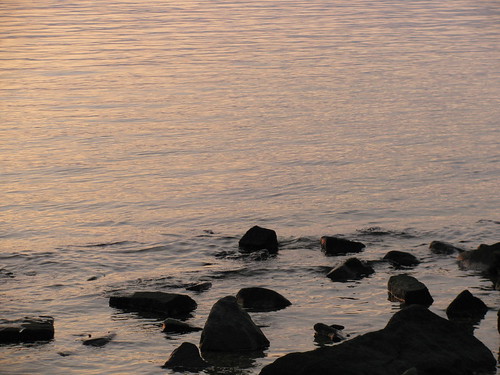
Rocks on the Shore photo by L.L. Barkat.

Labels: , , ,

25.1.10

Rethinking the Stubborn Child (and Big Person too)

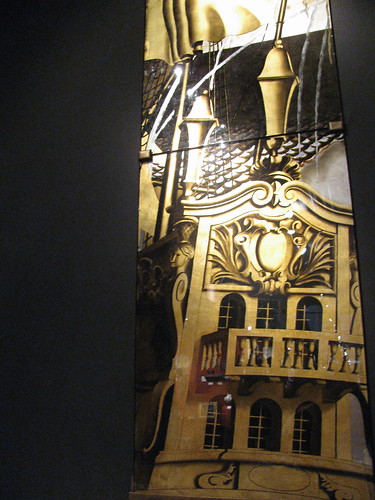
Golden Painting

I didn't have to coerce my Eldest into looking at this painting (above), or making observations about it. She freely made meaning and shared. She was happy when I took a picture and gave me advice on how best to capture the image.

That was Saturday.

Enter Monday, and the tackling of an assignment given by her teacher (from the 2-day enrichment program she attends weekly). Suddenly, my Eldest has morphed into a "stubborn child," who's giving me 10 reasons why this is a dumb assignment she shouldn't have to do.

Or, maybe something else is happening.

Reading Flow: The Psychology of Optimal Experience, I have several theories about the source of this "stubbornness."

First, let's consider the parameters of an "optimal experience" (as discussed in Flow):

"... a sense that one's skills are adequate to cope with the challenges at hand, in a goal-directed, rule-bound action system that provides clear clues to how well one is performing. Concentration is so intense that there is no attention left over to think about anything irrelevant, or to worry about problems. Self-consciousness disappears, and the sense of time becomes distorted." (p. 71)

Based on this definition, I might redefine what's going on in my daughter. Rather than seeing it as rebelliousness, laziness, or stubbornness (the common evaluations from authority figures in such a situation), I might instead consider that the assignment is (at least from her perspective):

1. too hard (her skills aren't nearly complex enough yet)
2. too easy (her skills are much more complex than needed)
3. lacking in clear goals
4. lacking in clear rules for how to approach it
5. lacking a built-in feedback system for knowing when "success" has been reached

With this alternate view in mind, I sat down with my daughter and did a little digging. I searched to understand why she was feeling angry. I focused my questions around the five possibilities above.

What I discovered was that, in a sense, all of these variables were at play. It took us about a half an hour to hash things out, and we finally landed on a solution that now has her upstairs in a "flow state."

Are you feeling "stubborn, lazy, or rebellious" (or is your child, or employee)? Maybe some very valid issues are blocking the flow.


Golden Building painting, photo by L.L. Barkat.

Labels: , , , , , ,

11.12.09

Conversations on Creativity

 Conversation, by Sara

How do you promote creativity in children? That's one question Christy Tennant asked me in her IAM Conversations podcast.

I tried to answer her question.

What I didn't get 'round to saying is that I believe children need authentic opportunities to share their work. This blog is one place I provide that for my children; they truly love hearing your feedback about their art and writing.

Also, to my great pleasure, when International Arts Movement discussed doing InsideOut: poems with me, they requested that I include a poem from each of my girls, and maybe some of Sara's art (in all, she ended up providing four illustrations).

And so it is. The children's creativity has been nurtured just a little bit more by providing opportunity. They've collaborated on a project that's open for the world to see.


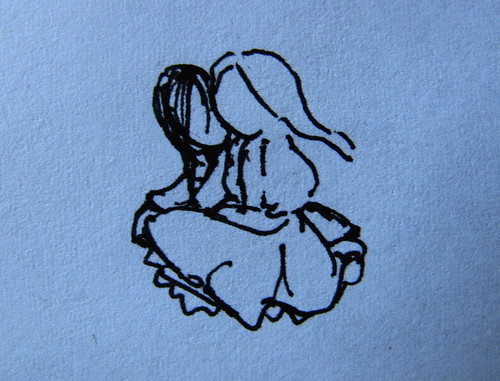
Sisters in Conversation pen and ink, by Sara. Used with permission.

Labels: , , , , , ,

1.12.09

Do Schools Kill Creativity?


All kids have tremendous talents and we squander them, ruthlessly.

We should treat creativity with the same status as we do literacy.

If you're not prepared to be wrong, you'll never come up with anything original. By organizing education so the worse thing is to be wrong, we are educating people out of their creative capacities.

The arts are at the bottom of the academic value system.

Our task is to educate a child's whole being.


These are some of the claims Ken Robinson makes in this TED talk. I tend to agree with him. But you probably guessed that a long time ago.

Labels: , ,