16.10.10

I Found My Sticky Writing in Bed
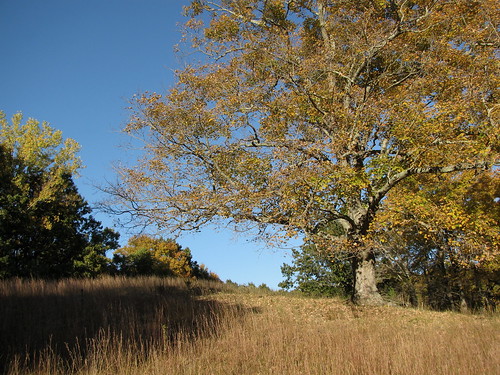
Autumn Trees at Pound Ridge

I wanted to write. But I felt empty of words. So I sat on my bed, opened How to Read a Poem: And Fall in Love with Poetry, and started... reading.

The author was talking about his first brush with grief poetry— the image of Achilles with his face in the dirt. The image stuck. So much so that when the author dealt with a friend's death years later, Achilles somehow consoled him.

"Poetry is a stubborn art," the author concluded. By this he meant that poetry refuses to let humanity go. It sets down a record of our deepest feelings. It gives us a place to lay our heads.

I sat in bed and thought about this. I thought about my struggle to write poetry. I realized I needed to let my poetry be a stubborn art.

It was raining, and I'd just been reading a poem in David Wheeler's upcoming book. You wouldn’t/ believe all the water teeming/ in the cracks of our streets/ ...We/could almost be swept away. The rhythm of rain was on my mind. I could almost feel it moist-tapping my skin.

So I began with the rain and this is what came (see below). Other poems, perhaps more stubborn and sticky, followed.

In the end, I found my sticky writing in bed. This wasn't on Heath & Heath's "how-to" list. But as Linda noted in one of her recent comments to me, sometimes a quiet place is where we find our best words, a place to lay our heads.

Aubade, October

I must hear my way
to the rain,
falling,
what do you do
when the rain is falling,
and whispered night comes early,
covers apples
in the orchard, red, unspoken for,
falling, falling...
like the rain.


Autumn Trees at Pound Ridge, photo by L.L. Barkat.

---

Over at TheHighCalling.org we're reading and discussing Made to Stick: Why Some Ideas Survive and Others Die, by Heath & Heath. Want to join us? :)

Labels: , , ,

2.4.10

How to Write a Poem

Ribboned Plant

The other day a good blogging friend told me he wants to write a poem, but he's afraid. As far as I know, he's never tried writing a poem before.

I understand his fear. Sometimes I cannot approach the empty page because I'm all tied up in knots with the thought of failure. What if my poem ends up being really terrible? Where do I start? What should I write about? It's like I'm writing a poem for the very first time again, and I stall.

In a way, I cannot explain how to write a poem. I told my friend, "Just write a sentence with a picture in it. Maybe use a memory or look at something that's near you. Break it into lines."

Would that be a poem?

My daughter asked me at the table yesterday, "What makes a poem a poem? Why isn't a book a poem? Or a movie a poem?"

We talked about the relative brevity of poems, but she interjected, "What about Beowulf?!" Okay, epic poems aren't short. But then she said, "Maybe Beowulf is a poem because it has 'form'." I liked that. Yes.

But we have to begin somewhere. Nobody wakes up and becomes Keats or Yeats, or the bard of Beowulf, in a day. Begin with a single sentence, or a phrase. Use a memory or something you see. Maybe pick up a few cool words from someone else's poems and play with them like a kid with a mudpie. Don't worry about what you're going to end up with.

Okay, I'm going to try it now. Just to see if it works. Of course I feel nervous doing this right here in front of you. But I want you to see that even poets feel afraid.

Here are my borrowed words, from the Yeats poem "The Wild Swans at Coole": scatter, wheeling, sore, passion.

Bananas soft curve
on counter, deep yellow
turning brown, sore with
wish to hang erect again,
green with passion
on the tree, scatter
sun to wheeling
birds, scatter
sun to wheeling
birds.

Fun. I had no intentions of writing a poem about bananas. Or wishes. Try it out, and if you do, drop your poem here in the comment box. I'd love to see what you found on your counter, your desk, or even in the bathroom. :)


Ribbon Plant photo, by L.L. Barkat.

Labels: , ,